Kaan · Article
2026-02-25
The Interface Layer for Autonomous Systems Is Collapsing Into Tool Calls
Terminal native AI agents now execute decisions, manipulate infrastructure, and manage entire systems without human intermediation.
The interface layer for autonomous systems is collapsing into tool calls.
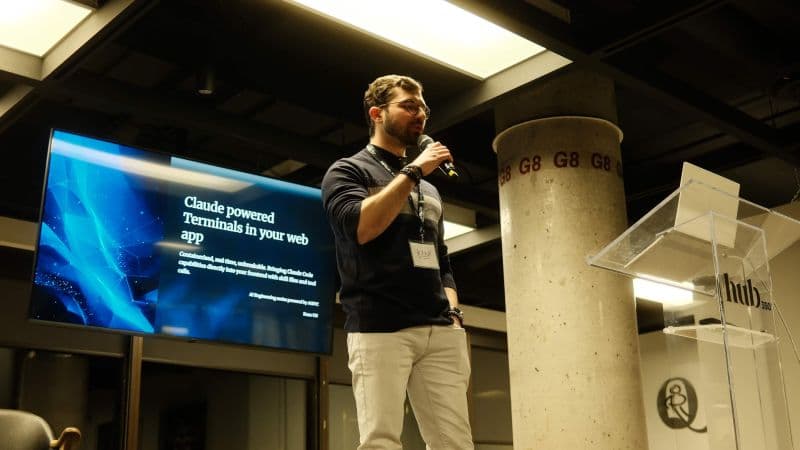
I demonstrated exactly what that acceleration looks like at a recent keynote sponsored by TELUS, L-SPARK and AI Tinkerers Ottawa. The room held senior engineers, policymakers, and operators all tracking the same inflection point: AI systems marked only the beginning. Terminal native AI agents now execute decisions, manipulate infrastructure, and manage entire systems without human intermediation.
With the latest technologies, we can build machines that automate complex judgment calls, provided we construct the right harnesses.
I want to thank our other speakers, Marc-Antoine Ruel Marco Domenico Tundo, MASc. Spencer Porter
My demo showcased a terminal tool that lives directly in the browser and transforms how teams interact with their infrastructure.
The system: • Fetches live CRM data and surfaces actionable updates • Deploys repository changes and database modifications in real time • Executes scripts within a controlled coding sandbox • Generates and refines skills based on repetitive task patterns • Uses skills, uses tool calls, reads codebase specifics
I designed this for concision. Every response delivers exactly what the operator needs. Every tool call executes with precision. When the system detects repetition, it automates the pattern into a reusable skill or script. It builds its own arsenal while respecting hard boundaries.
The thesis driving this architecture centers on production safety. AI accelerates throughput, but unlocking that capacity requires hierarchical control layers. My implementation enforces strict access protocols: readonly where appropriate, edit permissions gated by admin level usage, and tool execution bounded by explicit guardrails. Consistency and security remain non negotiable when agents operate within production codebases.
Beyond the technical architecture, this model eliminates friction for end users. Customers should be able to extract value from complex products through plain English commands instead of navigating opaque interfaces. Administrators should be able to get access to specified internal metrics and drive business decisions without filing support tickets or waiting for engineering cycles. It's a thesis that highlights the need to stop purchasing fragmented, overpriced SaaS tools for narrow automation tasks. You should be deploying an interface that is easy to communicate with, supported by sufficient tool calling capabilities and strict operational boundaries.
I remain intensely focused on this market shift. Organizations that master safe implementation of autonomous agent operations will capture disproportionate productivity gains. An agentic approach is becoming the central nervous system for production AI, and I am actively building (and speaking on) the hierarchical safety models required to make this deployable at scale.
Open to continuing this conversation with operators navigating the same challenges.